The State of Disposable Email, August 2026
As of August 9, 2026, we track 211,812 disposable email domains, and a live Domain Name System (DNS) sweep run the same day found that only 34.52 percent of them can still receive mail today. New throwaway domains appeared on every day of our 34 day observation window, 10,864 in all, so any static list starts going stale the moment it is published. And the most popular free blocklists miss most of the domains that are live right now, which is the finding that matters most if your job is to keep them out.
Headline findings
- We track 211,812 disposable email domains, and only 34.52 percent of them can still receive mail today.
- 135,083 of those domains, 63.77 percent, are already dead, which is dead weight any blocklist that carries them keeps flagging.
- 10,864 genuinely new disposable domains appeared in our 34 day window, an average of 319.5 per day.
- Of those 10,864 new domains, the widely used mailchecker blocklist contained 4.
- The most complete free list we tested still misses 61.16 percent of the disposable domains that are live right now.
- A single top level domain, .com, accounts for 37.01 percent of every disposable domain we track.
How many disposable email domains exist right now?
We currently track 211,812 disposable email domains, aggregated from multiple upstream sources and refreshed daily. That total is the accumulated picture, every throwaway domain the service has recorded and still lists, rather than a count of domains that work today. When we swept all 211,812 with live DNS on report day, 73,110 of them, 34.52 percent, could still receive mail, and the rest could not. So the honest headline is two numbers, not one: a large historical corpus, and a much smaller set of domains that are live at any given moment. Most of this report is about the gap between them.
How fast do new disposable domains appear?
Constantly. In the 34 day window from July 6 to August 8, 2026, after excluding the one time bulk import that seeded the dataset, we detected 10,864 genuinely new disposable domains, an average of 319.5 per day. Two of those days were one time intake events rather than organic discovery: a single refresh of one upstream list added 722 domains on July 9, and a newly added intake source came online on July 18 and contributed 4,200. Set those two days aside, and the remaining 32 days still averaged 185.7 new domains per day. Either way, the count never fell to zero, and 9,141 of the 10,864 new domains still pass MX validation today. These are working addresses, not noise.
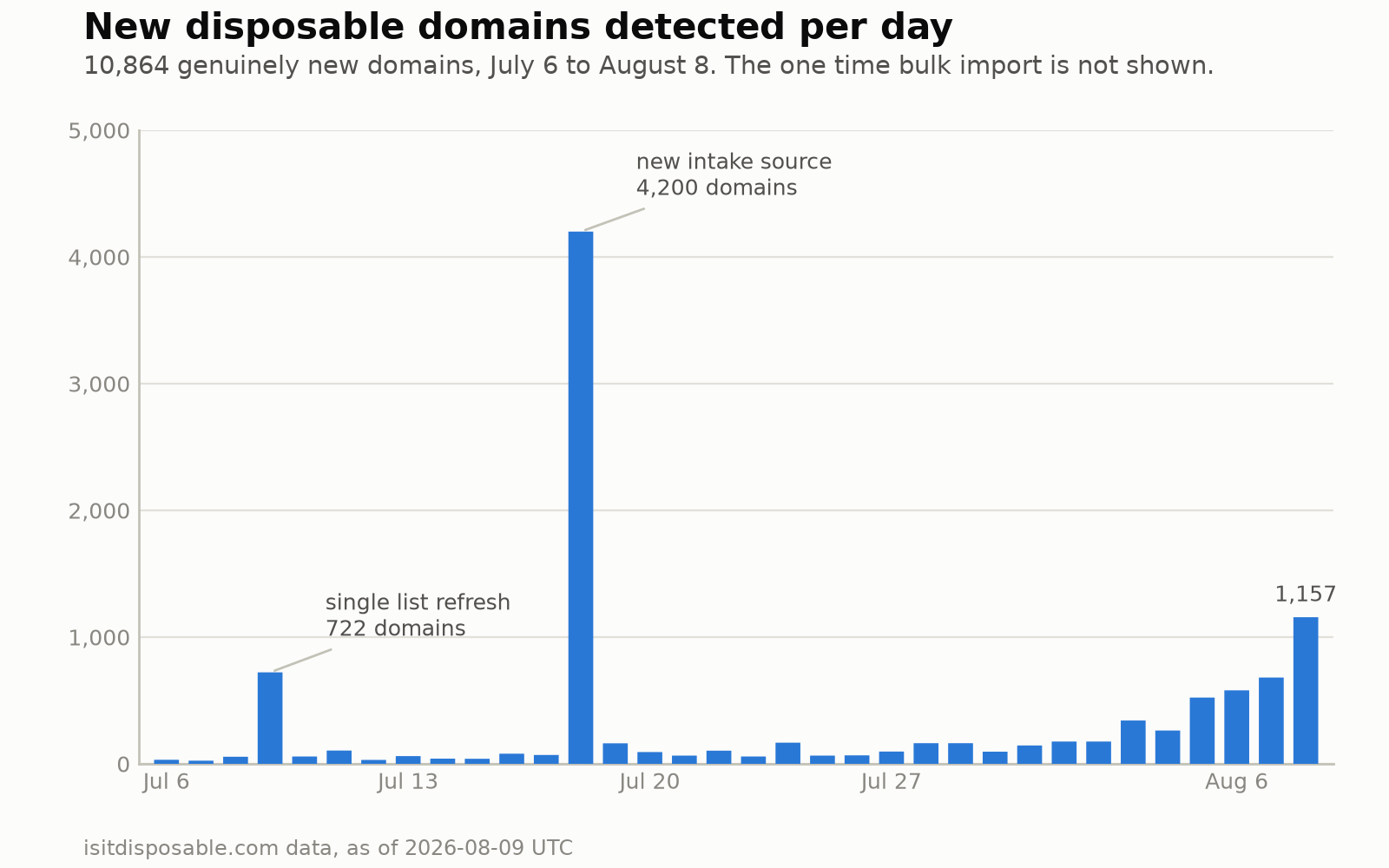
New disposable domains detected per day across the observation window. The one time bulk import that seeded the dataset is excluded.
New domains cluster by the mail infrastructure they route through, which is part of why they are catchable before they reach any public list. Grouping the window's new domains by the registrable root of their first mail host produces a short head of shared infrastructure.
| Mail infrastructure (MX root) | New domains routed through it, 34 days |
|---|---|
| cleantempmail.com | 719 |
| cloudflare.net | 597 |
| catchmail.io | 455 |
| 215.im | 391 |
| emailsrvr.com | 241 |
| unstablemail.com | 238 |
Read that table carefully. A cluster names shared infrastructure, not a disposable operator. Several, cloudflare.net and emailsrvr.com among them, are commodity mail hosts that disposable operators simply route through; the domains are disposable, the host is not. And 2,408 of the window's new domains have no mail host at all today, so they fall outside these clusters.
Which top level domains do disposable providers use, and why does the concentration matter?
Disposable domains concentrate heavily in a few top level domains (TLDs). Across all 211,812, the top five TLDs hold 116,814 domains, 55.15 percent of the dataset, out of 675 distinct TLDs in total. The single largest, .com, accounts for 78,400 domains, 37.01 percent.
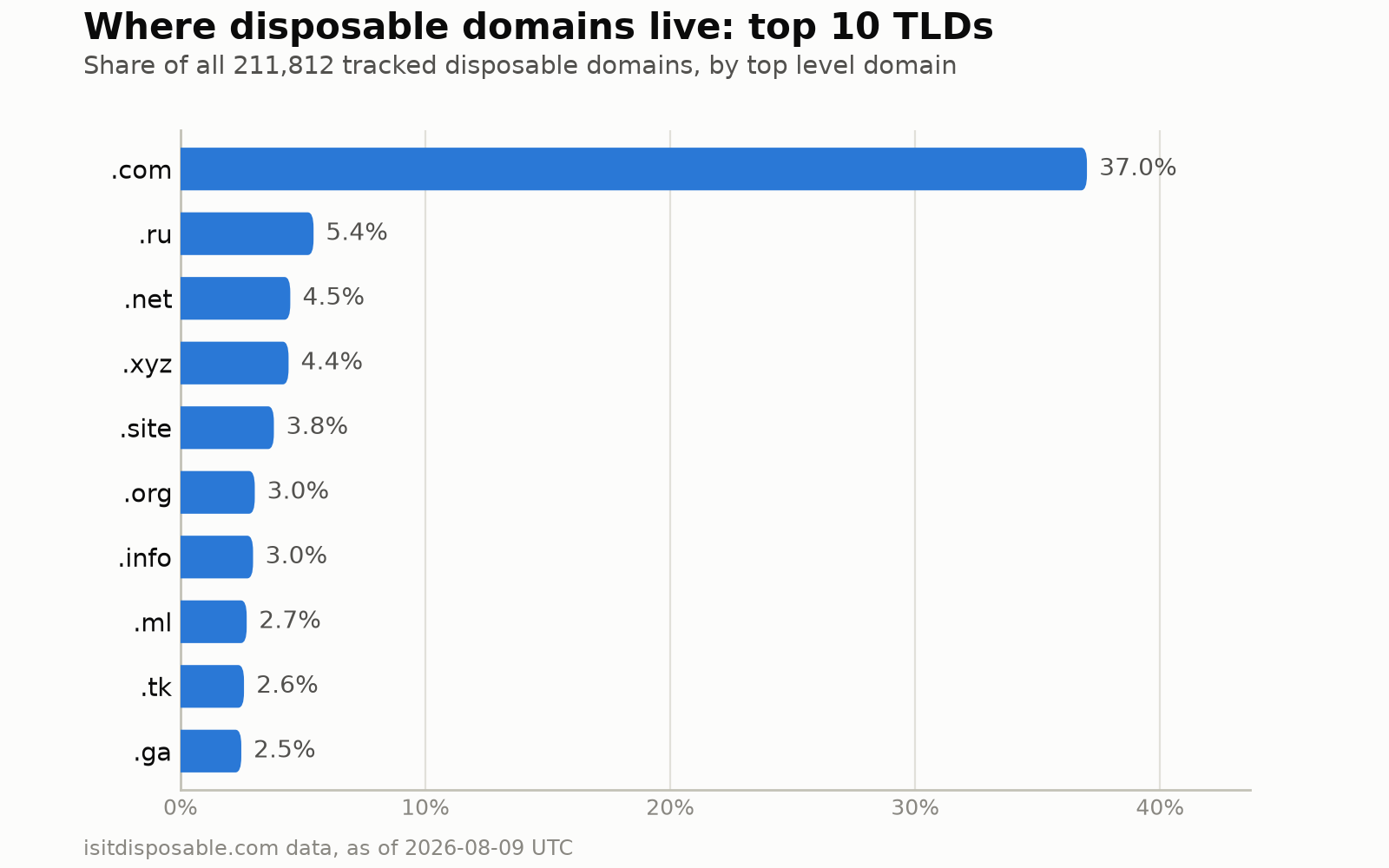
Share of all 211,812 tracked disposable domains, by top level domain.
The concentration is economic. Alongside .com sit the cheap new gTLDs .xyz and .site and the historically free ccTLDs .ml, .tk, and .ga, which cost almost nothing to register in bulk and abandon. When registration is effectively free, churn is free too, and an operator can cycle through domains as fast as they get blocked. That is the supply side of the dead weight measured below. For a defender, TLD alone is a weak signal, because .com dominates and is overwhelmingly legitimate; the long tail of cheap TLDs is a useful risk input, not a verdict.
The mix shifts for brand new domains, which is a leading indicator worth watching.
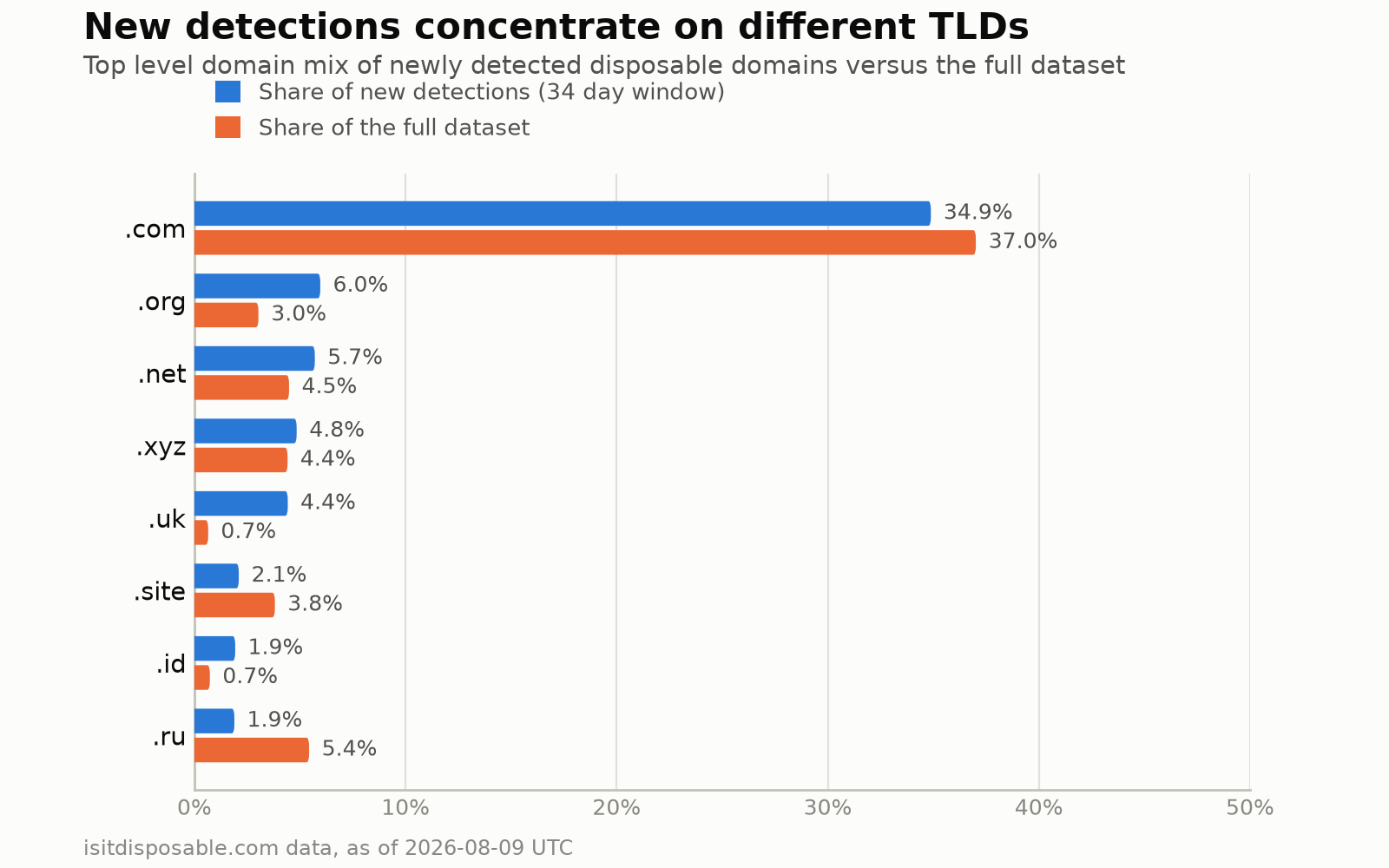
Top level domain mix of newly detected disposable domains versus the full dataset.
In the window, .com's share of new detections fell to 34.88 percent, while several TLDs ran well above their historical weight. .uk was 4.42 percent of new domains against 0.65 percent of the overall dataset, and .id 1.93 percent of new against 0.73 percent overall, while .ru, at 5.43 percent of the full corpus, was only 1.89 percent of new detections. Where new domains cluster today is not where the historical mass sits, so a detector tuned to yesterday's distribution will lag.
How much of the disposable ecosystem is already dead?
Most of it. Our report day sweep classified every tracked domain by whether mail could reach it.
| Status | Domains | Share of all 211,812 |
|---|---|---|
| Alive, mail could be delivered today | 73,110 | 34.52% |
| Dead, no mail route today | 135,083 | 63.77% |
| Unknown, transient DNS failure | 3,619 | 1.71% |
Of the 73,110 live domains, 46,724 publish working MX records and 26,386 qualify only through the RFC 5321 address record fallback, an A or AAAA record when no MX is present. Of the dead, 3,271, which is 1.54 percent of the dataset, publish an explicit null MX, covered in the next section. The 3,619 unknown domains hit transient DNS failures and count as neither alive nor dead.
Two cautions follow from a 63.77 percent dead rate. First, this is a property of the accumulated corpus, not a death rate over the window; most were historical entries that have since lapsed, and we do not present it as a lifespan figure. Second, dead entries are not harmless to carry. A domain that is dead today can be re-registered tomorrow by a legitimate owner, at which point a stale blocklist that still contains it starts rejecting real people. Dead weight is not just wasted space, it is a store of latent false positives, and it is the mirror image of the coverage gap. Both show up plainly in the free lists.
How well do the popular free blocklists actually perform?
We downloaded three widely used free blocklists from GitHub on report day and judged each against the same live MX sweep, so every list is measured by one consistent standard. All three are real, actively maintained community projects, and none of this reflects on the people who run them. A static list simply cannot keep pace with a target that moves every day.
| Blocklist | Entries | Live disposables it misses | Dead weight | New in our window it caught |
|---|---|---|---|---|
| disposable-email-domains | 8,201 | 66,939 (91.56%) | 1,926 (23.48%) | 222 of 10,864 |
| disposable/disposable | 74,688 | 44,717 (61.16%) | 45,437 (60.84%) | 419 of 10,864 |
| mailchecker | 56,356 | 54,940 (75.15%) | 37,491 (66.53%) | 4 of 10,864 |
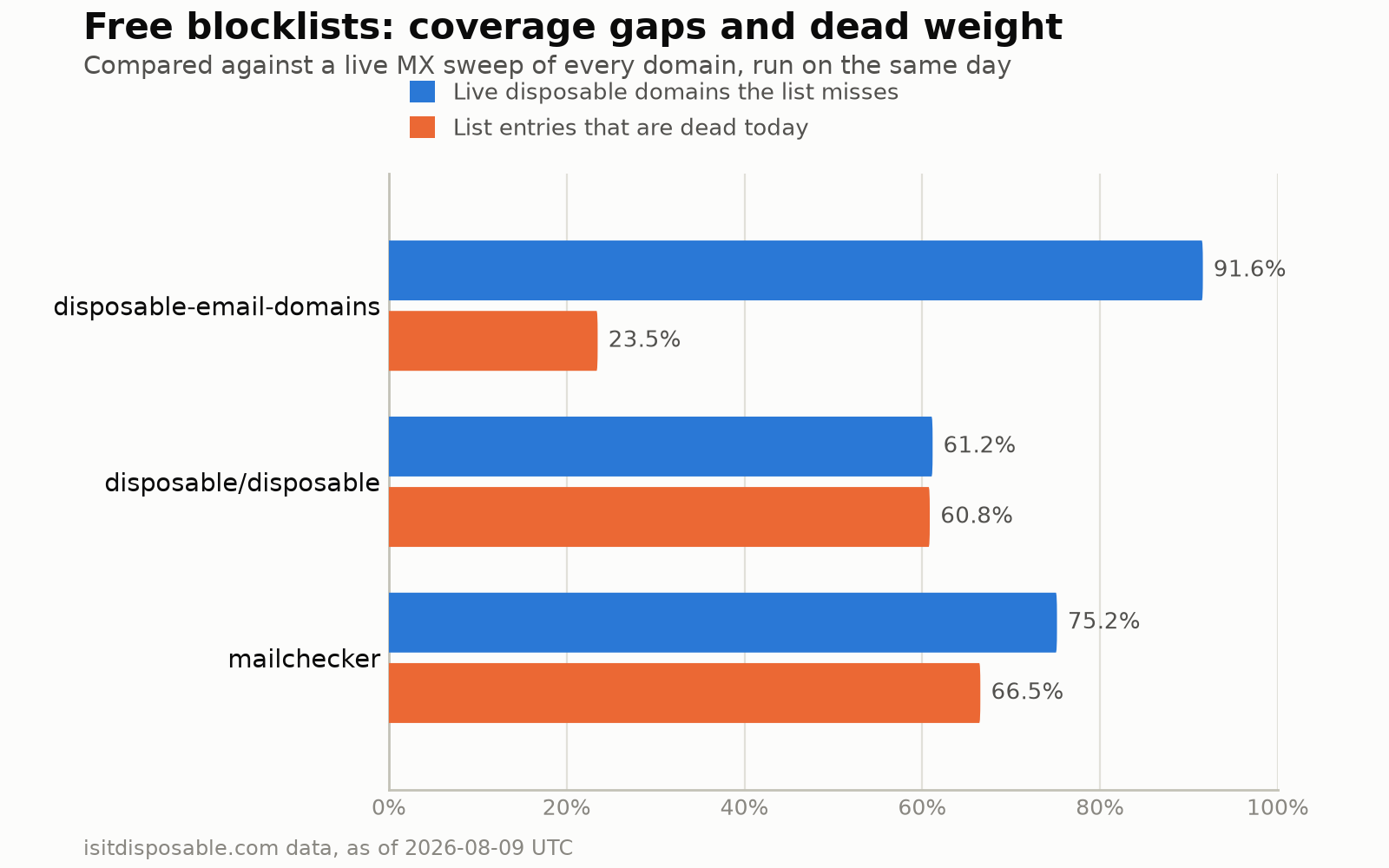
Free blocklist coverage gaps and dead weight, both measured against a live MX sweep of every domain run the same day.
Two failure modes matter, and they pull in opposite directions. Coverage is how many live disposable domains a list catches; freshness is whether it catches the new ones. On coverage, even the most complete list we tested, disposable/disposable with 74,688 entries, misses 44,717 of the 73,110 domains that are live right now, 61.16 percent. On freshness the gap is starker: of the 10,864 new domains from our window, disposable-email-domains contained 222, disposable/disposable contained 419, and mailchecker contained 4. And the lists are not lean in exchange for being current. Dead weight runs from 23.48 percent of disposable-email-domains up to 66.53 percent of mailchecker, so most of what mailchecker carries cannot receive mail at all.
In fairness, the comparison runs both ways. 85 domains appear in at least one of these three lists but not in ours, and every one of them sits on an upstream allow list our pipeline honors, so they are deliberate exclusions that protect relay services and long standing providers, not accidental gaps. We have not re-verified all 85 individually, so we state only what the data shows: each is an allow list exclusion.
What does a null MX record mean?
A null MX record is a domain declaring, in DNS, that it never accepts email. Defined in RFC 7505, it is a single MX record pointing at an empty root, and it is the domain owner's explicit statement that mail should not even be attempted. In our dataset, 3,271 domains, 1.54 percent of the total, publish one. For a detector this is the cleanest possible signal: no ambiguity, no transient failure to retry, just a stated refusal to receive mail. We count null MX domains among the dead, because by their own configuration that is what they are.
Why are relay services like Apple Hide My Email not disposable?
Because a relay address forwards to a real person's real inbox, and a disposable address does not. Conflating the two is a common and costly mistake. A disposable provider hands out a throwaway inbox that vanishes minutes later. A relay or forwarding service, Apple Hide My Email, Firefox Relay, SimpleLogin, addy.io, DuckDuckGo Email Protection, or Proton, gives a real person a permanent masked address that forwards to the mailbox they actually read. We track 12 relay domains across those 6 provider families and flag them as a separate signal for customers who want it, but they are never part of the disposable verdict and are never blocked by default. The people behind them are exactly the privacy conscious, often paying customers you want, so blocking them to stop throwaways is a self inflicted wound. That relay count reflects the providers shipped in the current product configuration, our deployed baseline, rather than a live database query.
What should you do if you run a signup form?
Start by naming the risk correctly, because it is miscast constantly. Letting throwaway signups through does not damage your sending reputation at Gmail, Outlook, or Yahoo. Those mailbox providers judge you on how their own users treat your mail, and a dead disposable domain is not one of their users. The real damage is one layer up, at your email service provider (ESP). When a disposable domain you accepted goes dead, and 63.77 percent of the ones we track already have, your next send to it hard bounces. A spike in hard bounces is one of the strongest list quality signals an ESP watches, and platforms like Mailchimp and SendGrid police it aggressively: a warning, a throttle, a forced list cleaning, or a suspension. That is the risk throwaway signups actually create. It is an account standing and deliverability problem at your ESP, not a Gmail reputation problem.
The data points to what a filter has to do. It has to catch domains that are live now, which is where the free lists fail on coverage. It has to catch the new ones as they appear, roughly 300 a day in our window, which is where they fail on freshness. And it has to avoid carrying dead entries that turn into false positives when a lapsed domain is re-registered. In practice that means validating the address at signup, blocking on a live disposable verdict, and letting relay addresses through. This report is drawn from the same live, MX validated dataset that isitdisposable.com uses to answer that question in one API call or a drop in snippet, refreshed daily and built to fail open, with a free plan and a full access trial if you want to test it against your own traffic.
Methodology
Every figure in this report comes from a read-only extraction of our production database on 2026-08-09 at 03:39:59 UTC, paired with a live DNS sweep of all 211,812 tracked domains run the same day. Nothing is estimated or extrapolated, and any metric we could not compute honestly is left out rather than guessed. The dataset is aggregated from multiple upstream sources and refreshed daily. Aliveness uses the same resolution rules we apply in production: an MX lookup first; an A and AAAA address record fallback per RFC 5321 when a domain has no MX record and no null MX; and the null MX convention per RFC 7505. Transient DNS failures were retried twice, and anything still unresolved is reported as unknown, never counted as dead.
The observation window is the 34 days from 2026-07-06 to 2026-08-08. The initial bulk import that seeded the dataset, 200,908 domains sharing a single load timestamp, is excluded from every growth figure and included in every snapshot figure; the current partial day is excluded from the window. This is the first monthly edition. Per domain lifespan and churn are deliberately not in it: computing them honestly needs per domain MX state recorded at load time and a full recheck history, neither of which exists yet, so we do not estimate them. That history is being built, and lifespan and mortality analysis will arrive in later editions as the window grows.
Cite this data
You are welcome to cite any statistic in this report. Please attribute it to the isitdisposable.com State of Disposable Email report, August 2026, and link to this page. If you need a figure that is not here, or a breakdown we have not published, ask, and we will see whether the data supports it.
About the author
Richelo Killian
Founder
Founder of isitdisposable.com and the SenderWorx email tool suite. Builds email infrastructure and anti-abuse tooling.