The State of Disposable Email, October 2026
As of October 6, 2026, we track 225,969 disposable email domains, and a live Domain Name System (DNS) sweep run the same day found 37.67 percent of them able to receive mail. This edition adds two firsts: a strict 30 day mortality figure, 3.88 percent of domains first observed alive were dead within 30 days, and a separation of returning domains from genuinely new ones. The churn now runs measurably in both directions, and most of this report is about what that movement means.
Headline findings
- We track 225,969 disposable email domains, and 37.67 percent of them can still receive mail today.
- The first strict 30 day mortality figure: 3.88 percent of the 78,810 domains first observed alive at least 30 days ago are dead at their latest recheck.
- Inside the 35 day window, 2,978 tracked domains went from alive to dead and 2,245 came back the other way.
- Outside intake days, genuinely new disposable domains arrived at 84.2 per day, and no day in the window produced zero.
- Of the window's 9,155 new domains, the widely bundled mailchecker blocklist contained 18.
- .ng supplied 8.75 percent of the window's new domains against 0.43 percent of the full dataset, about twenty times its historical share.
How many disposable email domains exist right now?
We currently track 225,969 disposable email domains. That total is the accumulated picture, not a count of domains that work today: the same day sweep found 85,130 domains, 37.67 percent, that could still receive mail, with 58,022 publishing working Mail Exchange (MX) records and 27,108 reachable only through the address record fallback that Request for Comments (RFC) 5321 defines. The gap between the two is the graveyard that rotation leaves behind.
How did the numbers move since September?
This is the third monthly edition, so the movement is becoming the story. Against the September 2026 edition:
| Metric | September 2026 | October 2026 |
|---|---|---|
| Domains tracked | 217,847 | 225,969 |
| Alive today | 78,224 (35.91%) | 85,130 (37.67%) |
| Genuinely new in window | 10,223 in 36 days | 9,155 in 35 days |
| Returning domains | not separated (the split did not exist yet) | 531 |
| Steady daily average outside intake days | 185.1 | 84.2 |
| Intake events | 1 (4,115 domains) | 4 (6,628 domains) |
| Strict 30 day mortality | CANNOT COMPUTE (not yet observable) | 3.88% |
| Top free list coverage gap | 91.7% | 91.7% |
Two comparison notes keep this honest. September's new domain figure predates the returning domain split, so it may include some returning domains and is not computed on an identical basis. And the steady daily average fell from 185.1 to 84.2, which we report as measured; the one definitional change the pack records is the returning domain exclusion described below.
How fast do new disposable domains appear?
In the 35 days from September 1 to October 5, we detected 9,155 genuinely new disposable domains, an average of 261.6 per day with a median of 85. Four intake events sit inside that total, described here exactly as the pack words them: on September 13, 3,846 domains arrived from a one time vetted addition of newly identified throwaway domains; on September 16, 336 domains arrived from a single refresh of one of our upstream lists; from September 29 through 30, 1,297 domains arrived from a multi day surge across several of our upstream lists; and on October 2, 1,149 domains arrived from a one time vetted addition of newly identified throwaway domains. Excluding those 5 intake days, the remaining 30 days averaged 84.2 genuinely new domains per day, and the quietest day of the window still produced 30.
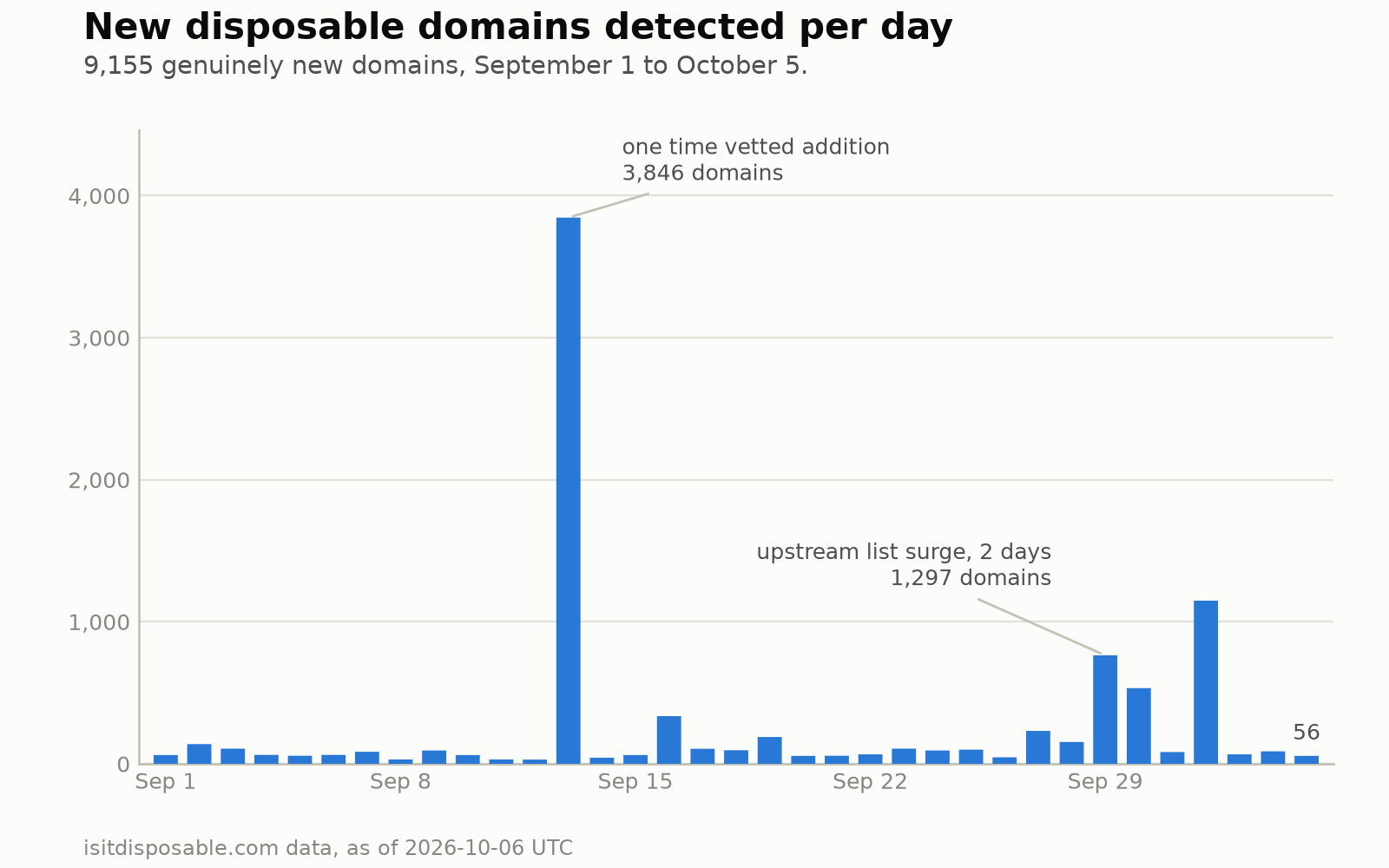
New disposable domains detected per day across the observation window. The one time bulk import that seeded the dataset is excluded.
The new arrivals are overwhelmingly real mail destinations: 8,563 of the 9,155 still pass MX validation today, with 559 already dead and 33 unknown. Grouped by the mail infrastructure they route through, the head reshuffled again: 71171171.xyz received 1,092 of the window's new domains, checkccv.info 795, tinyhost.shop 507, and moakt.com 354. The standing caution applies: a cluster names shared mail infrastructure, not necessarily a disposable operator, and several clusters are commodity mail hosts that operators simply route through. 1,133 of the window's new domains have no mail host today and sit outside any cluster.
What are returning domains, and why do they matter?
A domain that drops out of our dataset and is listed again later gets a fresh detection date, which until now made it look brand new. This month the report separates the two for the first time: every window domain was checked against the previous month's extraction snapshot, and 531 domains turned out to be returners, already tracked before September 1, so they are excluded from every new domain figure in this report. The figure is a floor, because a domain that left and came back between two snapshots still looks new. The practical point is bigger than the bookkeeping: domains cycle, and a defense that treats "seen before and gone" as "gone for good" will be wrong hundreds of times a month.
Which top level domains do disposable providers use, and why does the concentration matter?
Across all 225,969 domains, the top five top level domains (TLDs) hold 124,921, 55.28 percent of the dataset, out of 684 distinct TLDs, with .com alone at 83,043 domains, 36.75 percent.
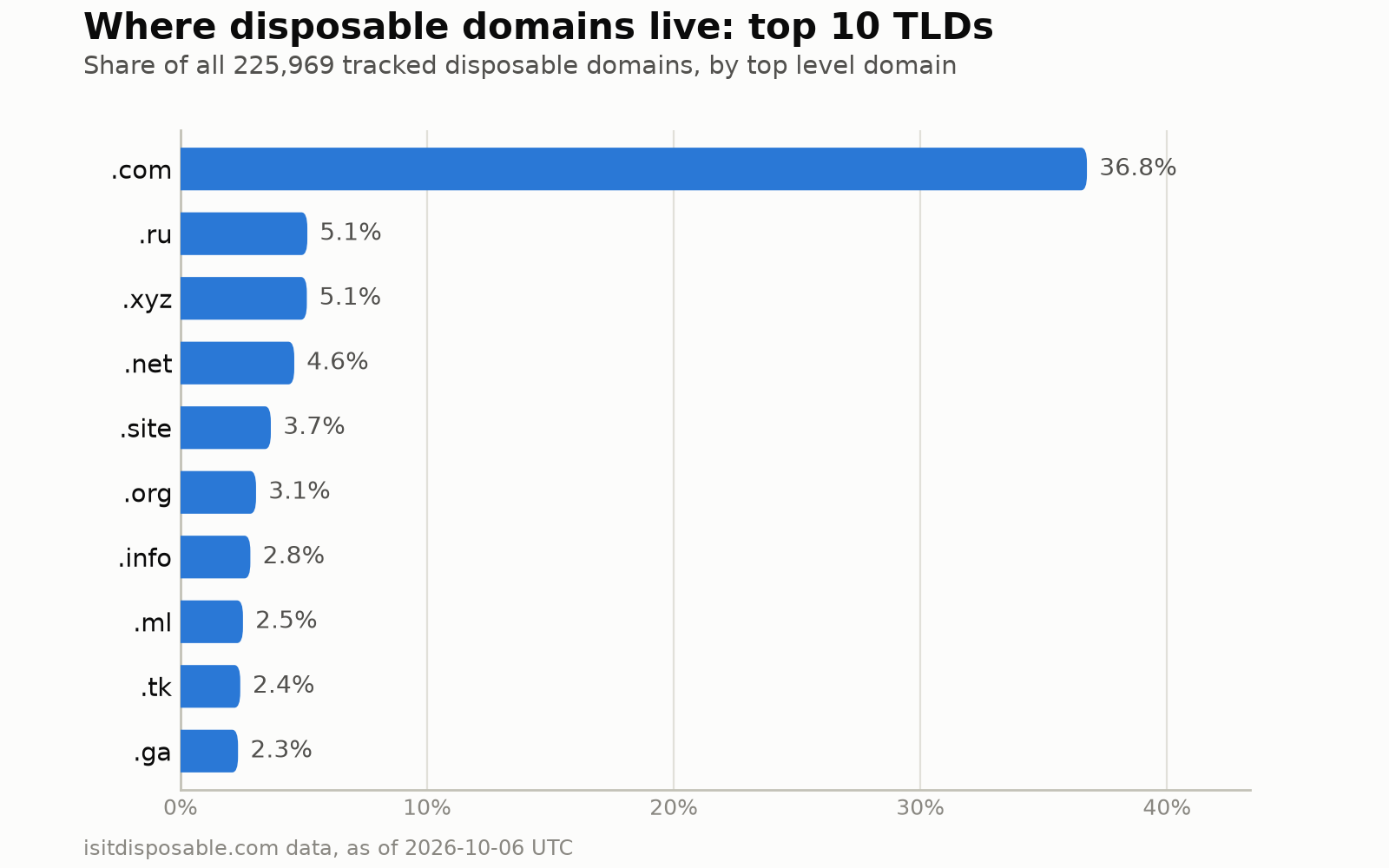
Share of all 225,969 tracked disposable domains, by top level domain.
The concentration is economic, pairing abundant cheap .com with discount new TLDs and historically free country codes, and the mix among new detections is where the economics show their speed.
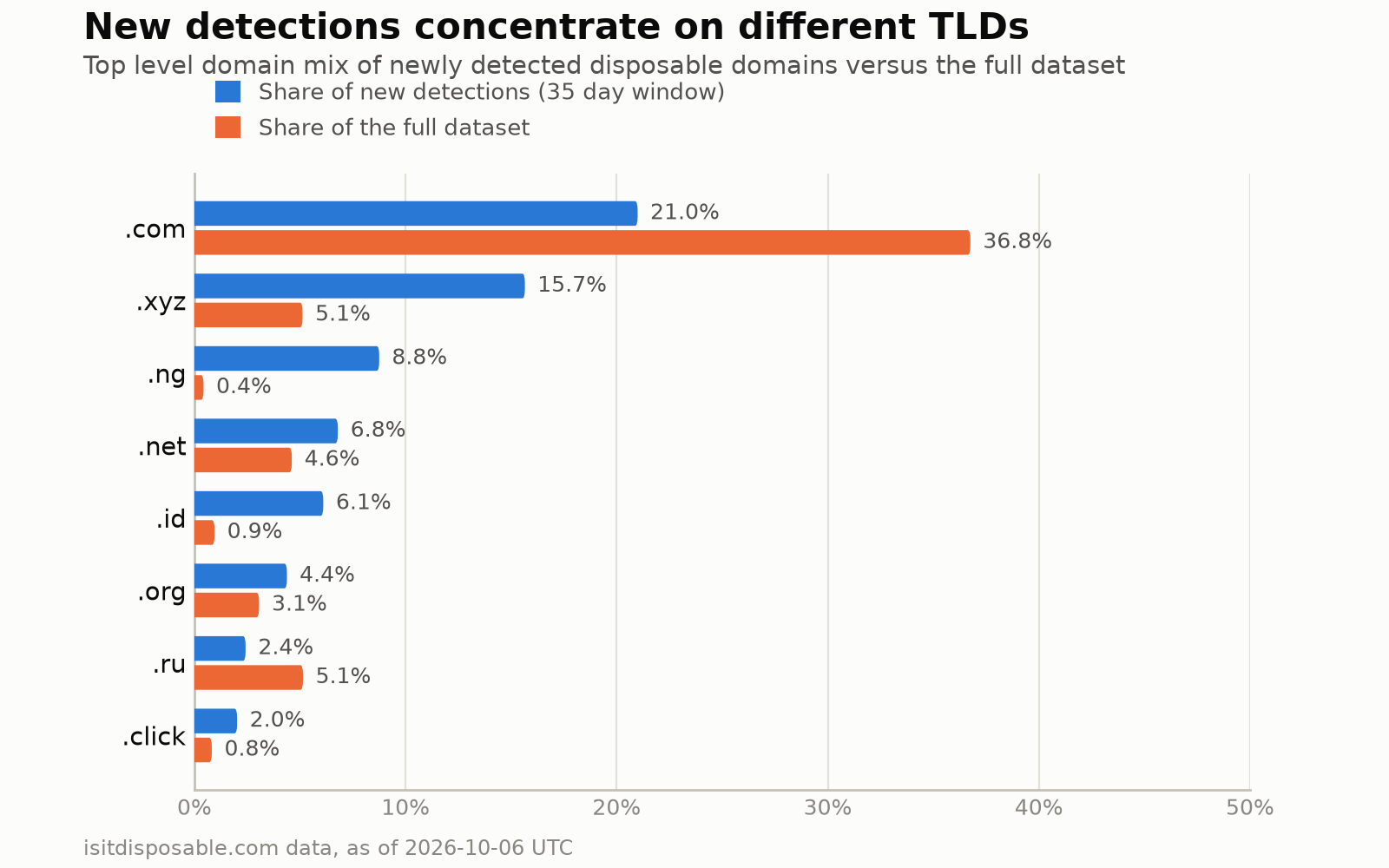
Top level domain mix of newly detected disposable domains versus the full dataset.
This month's mix is the most skewed the series has recorded. .com fell to 20.99 percent of new detections against 36.75 percent of the corpus, while .xyz ran at 15.65 percent of new against 5.12 overall and .ng, at 8.75 percent of new against 0.43 percent of the corpus, arrived at roughly twenty times its historical share. .id ran at 6.10 against 0.95, and .click and .me both well above weight. In September the hot TLDs were .com and .xyz; in October they are .xyz and .ng. Where new disposable domains concentrate keeps moving month to month, which is exactly why a detector tuned to the historical distribution lags the present.
How much of the disposable ecosystem is already dead?
| Status | Domains | Share of all 225,969 |
|---|---|---|
| Alive, mail could be delivered today | 85,130 | 37.67% |
| Dead, no mail route today | 136,896 | 60.58% |
| Unknown, transient DNS failure | 3,943 | 1.74% |
Of the dead, 133,578 have no mail route at all and 3,318, 1.47 percent of the dataset, publish an explicit null MX. The unknowns persisted through two retries and count as neither alive nor dead. The standing caution travels with the dead share: it describes the accumulated corpus, not a death rate, and dead entries are never harmless, because an expired domain re-registered by a legitimate owner turns every stale blocklist entry into a false block. This month's returning and resurrection figures put numbers on exactly that risk.
How quickly do live disposable domains die?
For the first time, this series can answer with the strict figure the recheck history was built for. Of the 78,810 domains first observed alive at least 30 days before the window end, 3,061, which is 3.88 percent, are dead or null MX at their latest recheck. That is the strict 30 day mortality of the live disposable population: roughly one in twenty-six live domains gone within a month of first being seen alive.
The broader observed decay reading now covers 84,349 domains first observed alive and rechecked since, of which 3,177, 3.77 percent, are dead or null MX at their latest recheck, over a median observation span of 50 days, up from September's early 1.84 percent over a 17 day median span; the longer the cohort is watched, the more of its deaths come into view. The churn inside the window ran in both directions, as it did last month but harder: 2,978 tracked domains went from alive to dead or null MX between September 1 and October 5, and 2,245 came back from dead or null MX to alive. More than five thousand status flips in five weeks is the measured version of the argument this series keeps making: any static snapshot of this population is wrong within days, in both directions.
How well do the popular free blocklists actually perform?
The same three community blocklists, downloaded fresh on report day and judged against the same live MX sweep. All three remain genuinely maintained, and this month one of them made a real move.
| Blocklist | Entries | Live disposables it misses | Dead weight | New in our window it caught |
|---|---|---|---|---|
| disposable-email-domains | 9,205 | 78,059 (91.69%) | 2,023 (21.98%) | 355 of 9,155 |
| disposable/disposable | 97,751 | 34,481 (40.50%) | 46,200 (47.26%) | 1,885 of 9,155 |
| mailchecker | 56,513 | 66,650 (78.29%) | 37,360 (66.11%) | 18 of 9,155 |
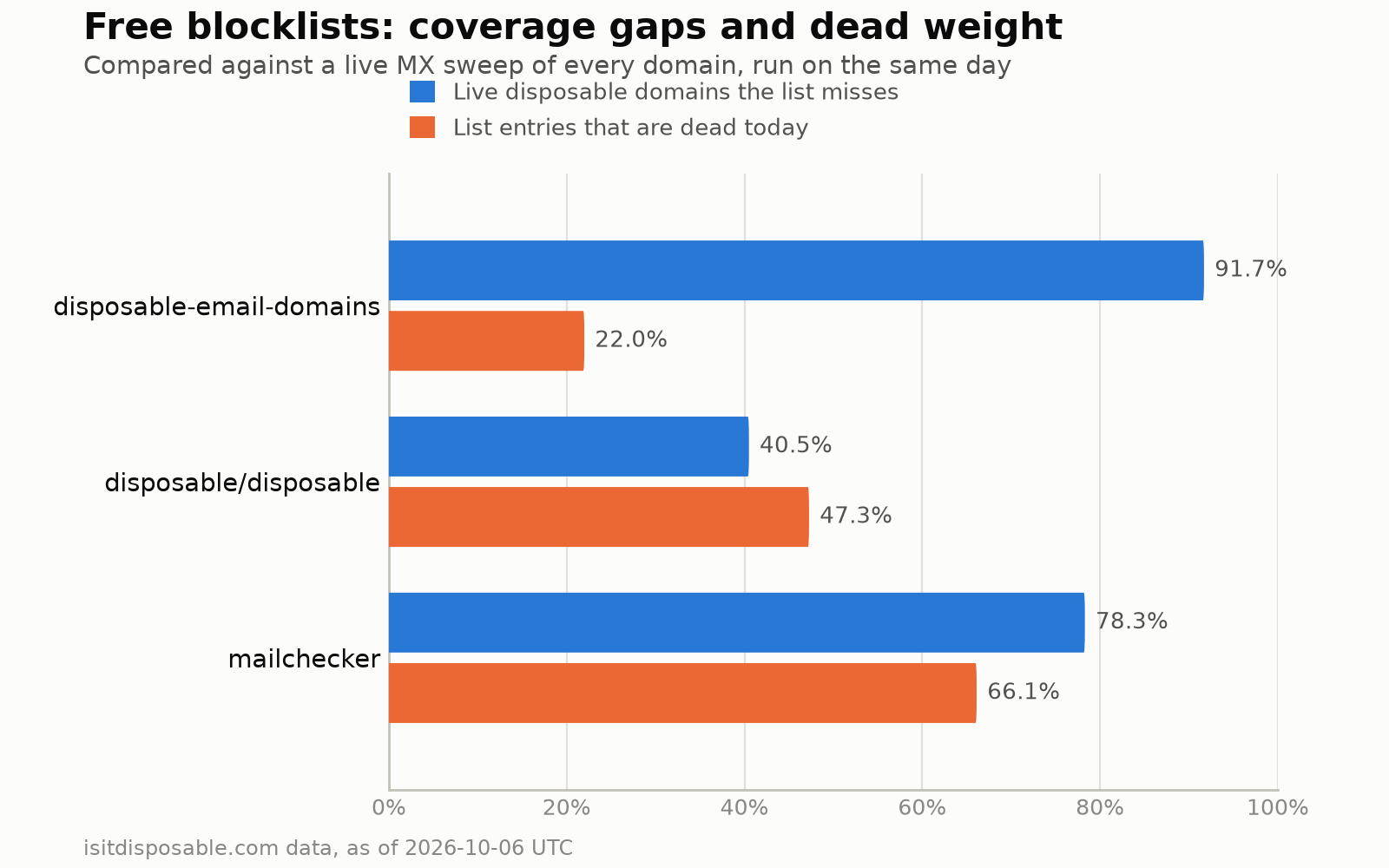
Free blocklist coverage gaps and dead weight, both measured against a live MX sweep of every domain run the same day.
Credit where it is due: disposable/disposable grew from 75,260 entries last month to 97,751 and cut its coverage gap from 63.07 percent to 40.50 percent, by far the best coverage any free list has posted in this series, and it caught 1,885 of the window's new domains. The structural limits still show on both ends of the table: the most widely copied list misses 91.69 percent of the domains that are live right now, mailchecker contained 18 of the 9,155 new arrivals, and dead weight runs from roughly a fifth to two thirds of the lists' own entries, each dead entry a latent false block. The reverse comparison also still holds: 69 domains appear in at least one of the three lists but not in ours, every one a deliberate exclusion because our pipeline honors allow lists that protect relay services and other legitimate domains.
What does a null MX record mean?
A null MX record is a domain declaring, in DNS, that it never accepts email: a single MX record pointing at the root, defined in RFC 7505, and the cleanest no-mail signal there is. In this month's dataset, 3,318 domains, 1.47 percent of the total, publish one, and we count them among the dead because by their own configuration that is what they are. The full mechanics, including why a null MX is the opposite of simply having no MX record, are in our null MX explainer.
Why are relay services like Apple Hide My Email not disposable?
Because a relay address forwards to a real person's permanent inbox, and a disposable address does not. A relay or forwarding service, Apple Hide My Email, Firefox Relay, SimpleLogin, addy.io, DuckDuckGo Email Protection, or Proton, gives a privacy conscious, often paying user a masked address that keeps working. We track 12 relay domains across those 6 provider families, a count that reflects the providers shipped in the current product configuration rather than a live database query, and they are flagged as a separate signal, never part of the disposable verdict, and never blocked by default. Twelve stable domains against 9,155 new throwaways in five weeks is the entire distinction in one comparison, and blocking relays turns away real customers while stopping no abuse.
What should you do if you run a signup form?
Name the risk correctly first. Letting throwaway signups through does not damage your sending reputation at Gmail, Outlook, or Yahoo; mailbox providers judge you on how their own users treat your mail, and a dead disposable domain has no users at any of them. The damage lands at your email service provider (ESP), and this month's mortality figure sharpens the timeline: 3.88 percent of live disposable domains die within 30 days of first observation, so a throwaway accepted today is measurably likely to hard bounce inside a month. Bounce spikes are among the strongest list quality signals platforms like Mailchimp and SendGrid police, with consequences that run from warnings to forced list cleanings to suspension. The fix stays the same because the data keeps saying the same thing: validate at signup against something that moves at the flow's speed, block confirmed throwaways with a clear message, let relay addresses through, and fail open so the check never breaks the form. This report is drawn from the same live, MX validated dataset that isitdisposable.com uses to do exactly that in one Application Programming Interface (API) call or a drop in snippet, with a free plan of 250 lookups a month and a 14-day full access trial, no credit card, if you want to watch your own signup traffic through this lens.
Methodology
Every figure in this report comes from a read-only extraction of our production database on 2026-10-06 at 10:37:09 Coordinated Universal Time (UTC), paired with a live DNS sweep of all 225,969 tracked domains run the same day. Nothing is estimated or extrapolated, and any metric that could not be computed honestly is labeled CANNOT COMPUTE with the reason. The dataset is built from six upstream lists refreshed every six hours, plus our own monitoring of the domain pools that throwaway providers advertise, with staff review of additions; none of them are named. Aliveness uses the same resolution rules we apply in production: an MX lookup first, an A and AAAA address record fallback per RFC 5321 when a domain has no MX record and no null MX, and the null MX convention per RFC 7505. Transient DNS failures were retried twice, and anything still unresolved is reported as unknown, never counted as dead.
The observation window is the 35 days from 2026-09-01 to 2026-10-05. The initial bulk import that seeded the dataset, 200,822 domains sharing a single load timestamp, is excluded from every growth figure and included in every snapshot figure; the extraction day is excluded from the window and had contributed 5 new domains by extraction time. Returning domains are separated from genuinely new ones by checking every window domain against the previous month's extraction snapshot, and all new domain figures exclude them. This is the third monthly edition, and the strict 30 day mortality figure is available for the first time, the recheck history begun on August 9 now covering 224,983 domains with every status change recorded. Customer and API usage statistics are not part of the public data series.
Cite this data
You are welcome to cite any statistic in this report. Please attribute it to the isitdisposable.com State of Disposable Email report, October 2026, and link to this page. If you need a figure that is not here, or a breakdown we have not published, ask, and we will see whether the data supports it.
About the author
Richelo Killian
Founder
Founder of isitdisposable.com and the SenderWorx email tool suite. Builds email infrastructure and anti-abuse tooling.